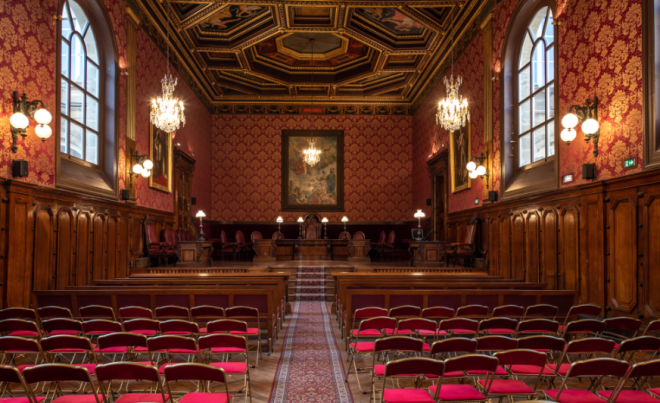
This courtroom became the most prestigious in the court under Napoleon III, who had the coffers of its ceiling decorated and bees painted on them, while placing his portrait on one side and that of his uncle Napoleon I on the other.
Originally, the space was divided into three areas:
- at the back, on a marquetry floor, the court, separated by several steps that symbolized its height and gave it a sense of majesty;
- in the center, in front of these steps, on a herringbone floor, the legal professionals, lawyers, solicitors, and litigants;
- at the entrance, on a stone floor, separated by a barrier that has now been removed but whose old fastenings remain visible, the litigants waiting for their case to be called and the public.
The judges of the court are seated in two rows : around the throne of the chief justice, each chamber president has a chair whose location is determined by protocol based on seniority and rank. Behind the presidents, the judges have a bench against the three walls.
The magistrates of the public prosecutor’s office are seated on the left around the public prosecutor, whose chair and desk form a space that protrudes toward the public.
Opposite them, on the right, also protruding toward the public, the court clerks surround their chief clerk.
The decoration chosen by Napoleon III means that upon entering, visitors are greeted by the words “jus romanum” (Roman law) on the ceiling, while above the door, the name “Justinian” reminds them of the famous jurist who had a lasting influence on ancient law.
Opposite them, on the ceiling, the words “Code Napoléon” and, on the wall at the back of the room, the name “Napoleon I” echo this as a sign of the new legal era, with the Emperor of the French succeeding the Emperor of the Romans. Above the magistrates of the court, around the skylight, are painted the names of the figures whose statues adorn the façade. On the walls around the room are the names of various famous jurists.
On the back wall, above the judges, a painting by Duvignau has replaced since 1934 the lime wood crucifix given in 1816 by the king to the royal criminal court sitting at Fort-du-Hâ and moved in 1946 when the courthouse was built.
This painting represents an allegory of the spirit of the laws. On the right, we see Persians discussing their mail; below, a Roman soldier after the decline of his empire; in the middle, Montesquieu’s funeral urn from which the spirit of the laws escapes, next to his chamber president’s mortarboard. The whole scene is centered on a harbor filled with boats, which upon closer inspection can be identified as the Port de la Lune.